

In traditional assembly, welding aluminum is a notoriously difficult task. Conventional fusion welding melts the metal, often leading to porosity, warping, and a significant drop in structural integrity at the joint.
COBOGGI bypasses these thermal pitfalls using Friction Stir Welding (FSW)—a solid-state joining process that "blends" two pieces of aluminum together without ever reaching the melting point.
The Science of Plastic Deformation
FSW doesn't use a flame or an arc. Instead, it uses a non-consumable rotating tool with a specialized probe.
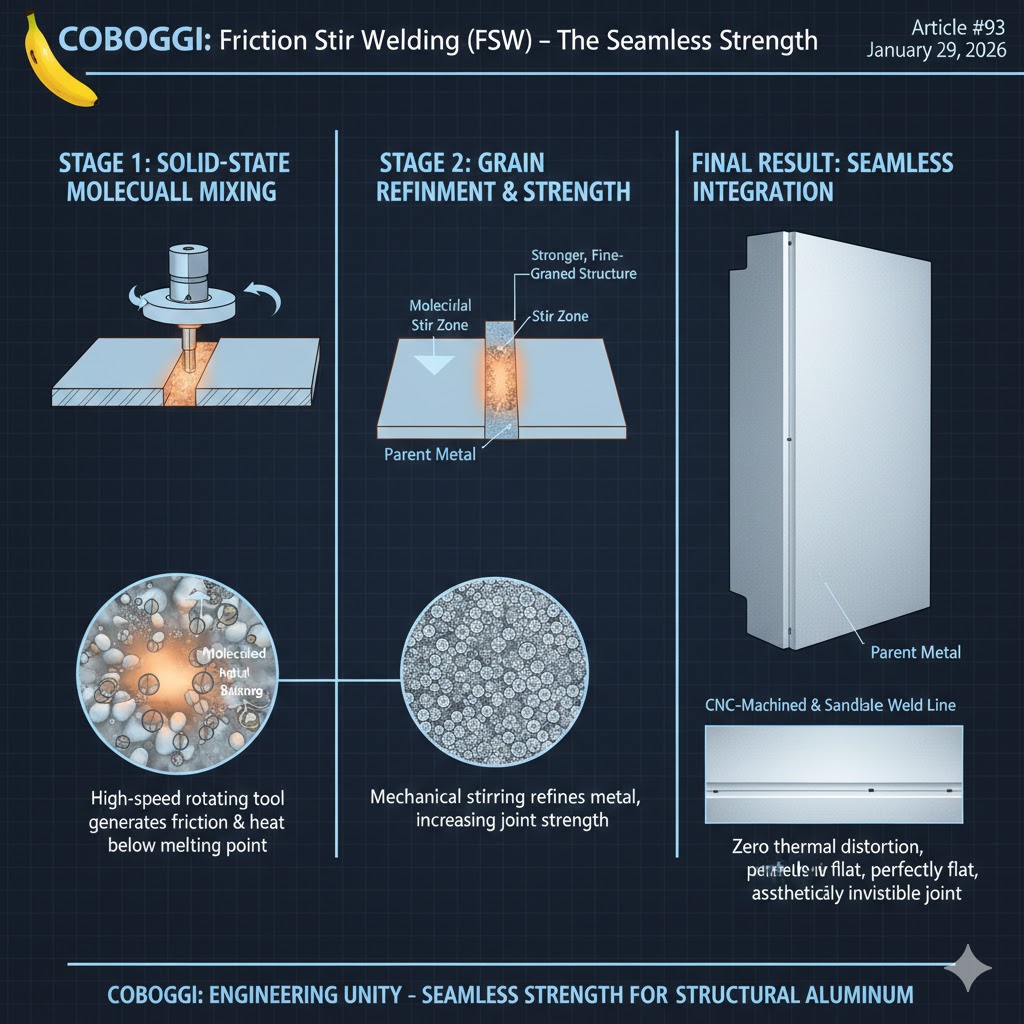
1. Solid-State Molecular Mixing
As the tool rotates and plunges into the interface between two aluminum plates, the friction generates localized heat. This softens the metal into a "plasticized" state. The tool then moves along the joint line, mechanically stirring the molecules of both pieces together. Because the aluminum stays below its melting point (Tm ≈ 660℃), there is no liquid-to-solid shrinkage, resulting in a joint that is virtually defect-free.
2. Grain Refinement and Strength
Unlike traditional welds, which create a brittle "cast" structure, FSW actually refines the grain structure of the metal. The intense mechanical stirring creates a "fine-grained" stir zone that is often stronger than the surrounding base metal.
This allows COBOGGI to create monolithic-strength enclosures from multiple extruded or machined parts.
3. Zero-Gap Aesthetic Integration
Because FSW produces minimal heat distortion, the joined parts maintain their precise dimensions.
After the weld is complete, the surface is CNC-machined and sandblasted, rendering the joint completely invisible to the eye and the touch.
This "seamless" look is essential for the unibody appearance of high-end electronics and automotive panels.
Conclusion: Engineering Unity
Friction Stir Welding is the ultimate assembly tool for structural aluminum.
It allows COBOGGI to join complex geometries with the strength of a single piece of metal, ensuring that our hardware is as robust as it is beautiful.
 English
 German
 French
 Russian
 Spanish
 Japanese
 Korean
 Khmer
Khmer Portuguese
 Ukrainian
 Arabic
 Italian
 Afrikaans
 Albanian
 Armenian
 Azerbaijani
 Basque
 Belarusian
 Bulgarian
 Catalan
 Croatian
 Czech
Czech Danish
 Dutch
Dutch Estonian
 Filipino
 Finnish
 Galician
 Georgian
 Greek
Greek Haitian Creole
 Hebrew
 Hindi
Hindi Hungarian
 Icelandic
 Indonesian
 Irish
Irish Latvian
 Lithuanian
 Macedonian
 Malay
Malay Maltese
 Norwegian
 Persian
 Polish
 Romanian
 Serbian
 Slovak
 Slovenian
 Swahili
 Swedish
 Thai
Thai Turkish
 Urdu
Urdu Vietnamese
 Welsh
Welsh Yiddish