

In the evolution of CMF (Color, Material, Finish), laser technology has transitioned from a tool for simple serialized branding to a sophisticated method for creating functional micro-topographies.
COBOGGI leverages high-speed fiber lasers to engineer textures that are too intricate for mechanical tools and too precise for chemical etching.
The Physics of Laser Ablation
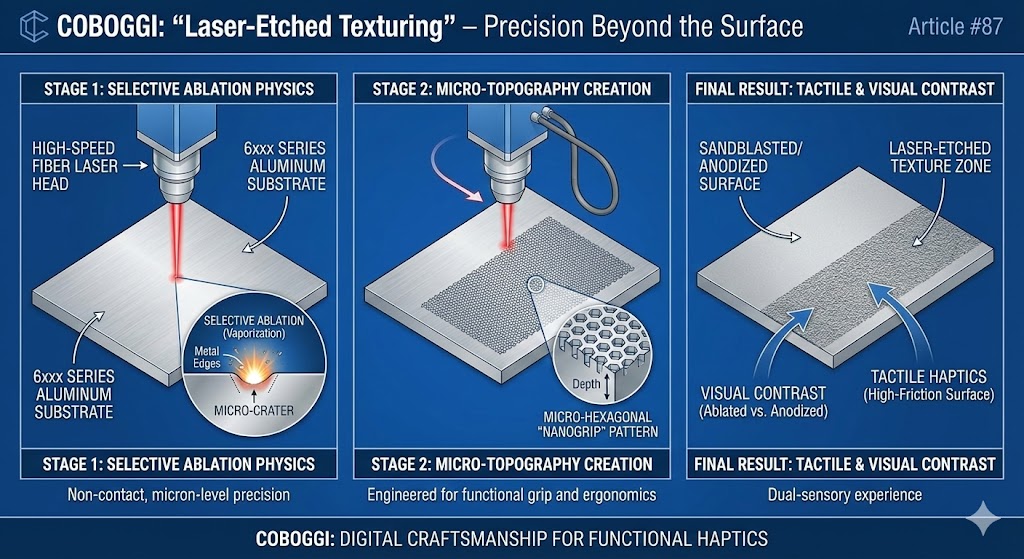
Laser-etched texturing works through selective ablation, where a concentrated beam of light vaporizes the surface of the aluminum in nanosecond bursts. This allows for the creation of patterns with micron-level depth and spacing on 6xxx and 5xxx series alloys.
1. Precision Micro-Topography
Unlike mechanical knurling, which deforms the metal, laser etching removes material with zero physical contact. This means we can create incredibly fine textures—such as micro-hexagons or cross-hatched "nanogrips"—on ultra-thin aluminum walls without risking structural distortion or internal component interference.
2. Functional Friction and Ergonomics
By adjusting the laser's frequency and pulse duration, COBOGGI can tune the "coefficient of friction" on specific areas of a device. For example, a laptop’s palm rest or a handheld controller's grip zones can be etched with a texture that prevents slipping while remaining smooth to the touch.
This "haptic engineering" ensures the device feels secure without the abrasive "bite" of traditional textures.
3. High-Contrast Haptics
Laser etching creates a unique tactile contrast. When applied over a sandblasted or anodized surface, the laser-ablated areas expose a different grain structure of the aluminum.
This creates a dual-sensory experience: a visual difference in light absorption (matte vs. dark/burnt or bright/ablated) and a tactile difference in surface height that the user can feel immediately.
Conclusion: Digital Craftsmanship
Laser-etched texturing represents the "digital" frontier of metal finishing. It allows COBOGGI to move away from uniform surfaces toward intelligent, localized texturing that serves both the aesthetic vision and the functional requirements of high-performance hardware.
 English
 German
 French
 Russian
 Spanish
 Japanese
 Korean
 Khmer
Khmer Portuguese
 Ukrainian
 Arabic
 Italian
 Afrikaans
 Albanian
 Armenian
 Azerbaijani
 Basque
 Belarusian
 Bulgarian
 Catalan
 Croatian
 Czech
Czech Danish
 Dutch
Dutch Estonian
 Filipino
 Finnish
 Galician
 Georgian
 Greek
Greek Haitian Creole
 Hebrew
 Hindi
Hindi Hungarian
 Icelandic
 Indonesian
 Irish
Irish Latvian
 Lithuanian
 Macedonian
 Malay
Malay Maltese
 Norwegian
 Persian
 Polish
 Romanian
 Serbian
 Slovak
 Slovenian
 Swahili
 Swedish
 Thai
Thai Turkish
 Urdu
Urdu Vietnamese
 Welsh
Welsh Yiddish