

In traditional manufacturing, a single aluminum component is typically restricted to a single color. If a designer wants a dual-tone effect, it usually requires multiple parts and complex assembly.
COBOGGI defies this limitation through Multi-Color Oxidation Protocols, allowing for distinct, high-contrast color zones on a single, monolithic piece of aluminum.
The Precision of Selective Anodizing
Creating multiple colors on one substrate is a high-stakes electrochemical dance. It requires perfect timing and absolute chemical isolation to prevent "bleeding" or "smudging" between color boundaries.
1. Advanced Masking Techniques
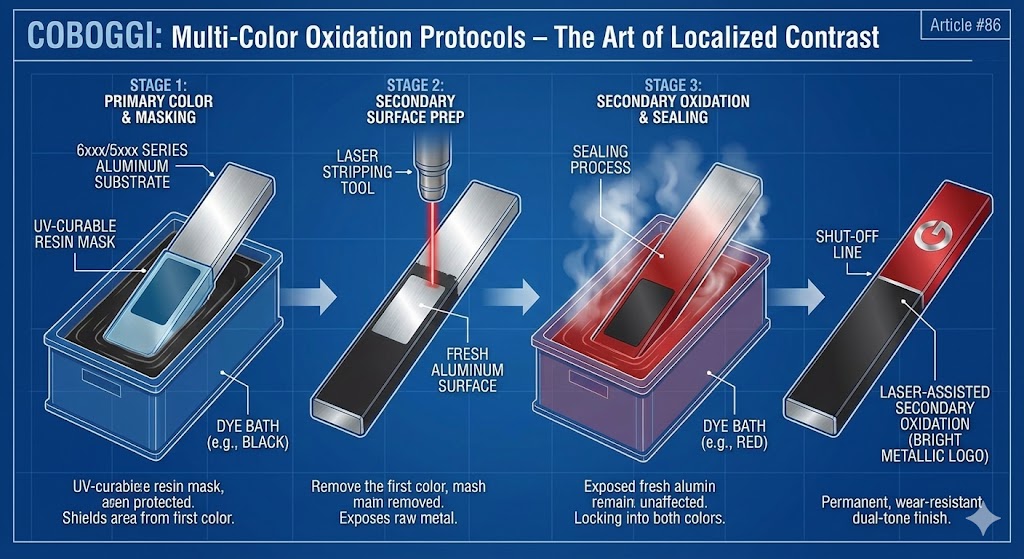
The foundation of multi-color oxidation is the barrier. We utilize high-precision UV-curable resins or custom-fitted physical masks to shield specific areas of the 6xxx or 5xxx series aluminum during the first anodizing cycle.
These masks must withstand the acidic environment of the electrolyte bath without lifting or degrading, ensuring a razor-sharp "shut-off line" between colors.
2. Sequential Dyeing and Re-Anodizing
Once the first color is locked into the oxide layer and sealed, the mask is removed. The part then undergoes a secondary surface preparation—often involving localized etching or laser stripping—to expose the raw aluminum in the previously masked areas. This "fresh" metal is then anodized and dyed a second time. Because the first color is already sealed, it remains unaffected by the second chemical bath.
3. Laser-Assisted Secondary Oxidation
For complex logos or functional markings, COBOGGI employs laser-assisted stripping. A high-precision fiber laser removes the primary anodic layer with micron-level accuracy.
The part is then re-processed to create a contrasting color or a "bright" metallic highlight within the etched area, providing a permanent, wear-resistant branding solution that is flush with the surface.
Conclusion: Beyond the Mono-Tone
Multi-color oxidation transforms a simple structural component into a sophisticated branding asset.
By eliminating the need for separate parts to achieve color variety, COBOGGI reduces assembly complexity while offering designers a wider palette of CMF (Color, Material, Finish) possibilities.
 English
 German
 French
 Russian
 Spanish
 Japanese
 Korean
 Khmer
Khmer Portuguese
 Ukrainian
 Arabic
 Italian
 Afrikaans
 Albanian
 Armenian
 Azerbaijani
 Basque
 Belarusian
 Bulgarian
 Catalan
 Croatian
 Czech
Czech Danish
 Dutch
Dutch Estonian
 Filipino
 Finnish
 Galician
 Georgian
 Greek
Greek Haitian Creole
 Hebrew
 Hindi
Hindi Hungarian
 Icelandic
 Indonesian
 Irish
Irish Latvian
 Lithuanian
 Macedonian
 Malay
Malay Maltese
 Norwegian
 Persian
 Polish
 Romanian
 Serbian
 Slovak
 Slovenian
 Swahili
 Swedish
 Thai
Thai Turkish
 Urdu
Urdu Vietnamese
 Welsh
Welsh Yiddish