

In the quest for extreme miniaturization and intricate detailing, traditional CNC machining eventually reaches its mechanical limits. When a design requires holes smaller than a needle point or patterns too complex for a physical cutting bit, COBOGGI turns to Photo-Chemical Etching (PCE).
This process allows us to "machine" aluminum using light and chemistry, achieving a level of precision that is fundamentally stress-free and burr-free.
The Photolithographic Workflow
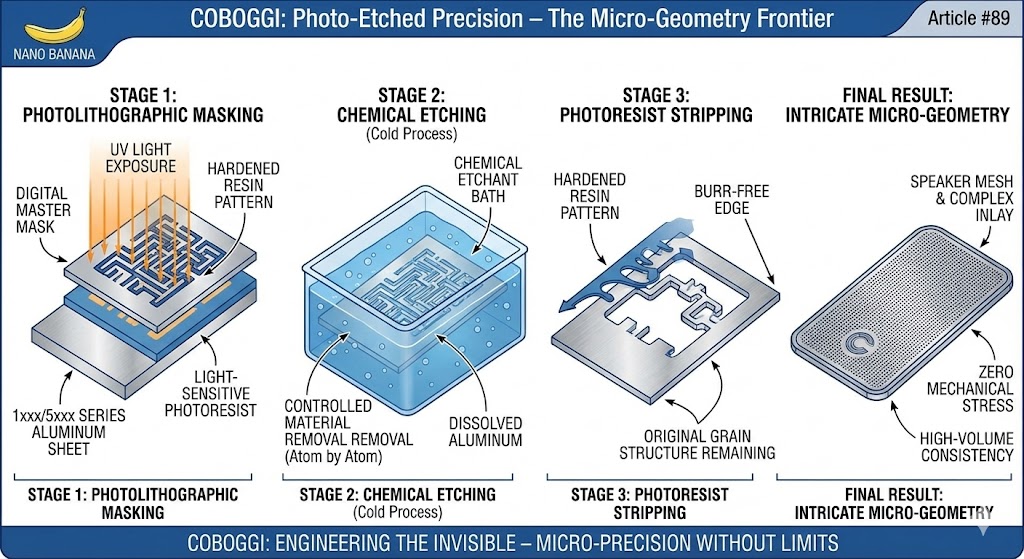
Photo-etching is essentially a high-tech subtractive process that uses a light-sensitive resin (photoresist) to protect specific areas of the aluminum while a chemical etchant removes the rest.
1. The Digital Master Mask
The process begins with high-resolution CAD data, which is converted into a photographic "tool" or mask. Because this tool is optical rather than physical, there is no tool wear.
This ensures that the first part produced is identical to the millionth, making it ideal for high-volume, high-precision components like speaker grilles, micro-meshes, and decorative inlays.
2. Chemical Dissolution vs. Mechanical Cutting
Unlike CNC milling, which can introduce heat-affected zones and mechanical stress into the 1xxx or 5xxx series aluminum, photo-etching is a cold process.
The chemical etchant dissolves the metal atom by atom. This results in parts that remain perfectly flat, with no burrs, sharp edges, or altered grain structures—critical for internal electronic shielding and high-end aesthetic interfaces.
3. Complexity at No Extra Cost
In traditional machining, complexity equals cost. In photo-etching, a sheet with one hole costs the same to etch as a sheet with ten thousand holes. This allows COBOGGI to offer designers total creative freedom.
We can create intricate "lace-like" textures, varying-density apertures, and complex branding elements that would be economically or physically impossible via traditional means.
Integration with Coboggi Finishes
Once the photo-etched geometry is complete, the parts move to our specialized anodizing lines. Because the etched edges are chemically clean, the anodic oxide layer forms with perfect uniformity, ensuring that even the microscopic "walls" of an etched mesh are fully protected against corrosion and wear.
Conclusion: Engineering the Invisible
Photo-etched precision allows COBOGGI to operate at the scale of the microscopic. By combining the accuracy of photography with the durability of aluminum, we provide the essential details that define the next generation of high-performance hardware.
 English
 German
 French
 Russian
 Spanish
 Japanese
 Korean
 Khmer
Khmer Portuguese
 Ukrainian
 Arabic
 Italian
 Afrikaans
 Albanian
 Armenian
 Azerbaijani
 Basque
 Belarusian
 Bulgarian
 Catalan
 Croatian
 Czech
Czech Danish
 Dutch
Dutch Estonian
 Filipino
 Finnish
 Galician
 Georgian
 Greek
Greek Haitian Creole
 Hebrew
 Hindi
Hindi Hungarian
 Icelandic
 Indonesian
 Irish
Irish Latvian
 Lithuanian
 Macedonian
 Malay
Malay Maltese
 Norwegian
 Persian
 Polish
 Romanian
 Serbian
 Slovak
 Slovenian
 Swahili
 Swedish
 Thai
Thai Turkish
 Urdu
Urdu Vietnamese
 Welsh
Welsh Yiddish