

When you look at a flagship smartphone or a high-end audio dial, you often see a thin, glittering line of bright metal tracing the perimeter.
This isn't just a "pretty line." It is a functional bevel, and its engineering is a Masterclass in balancing aesthetic "pop" with mechanical necessity.
At Coboggi, we treat the edge as a critical engineering zone. How we finish a corner dictates how the product feels in the hand, how it survives a drop, and how it catches the light on a retail shelf.
1. "Edge Light" Physics: The Visual ROI
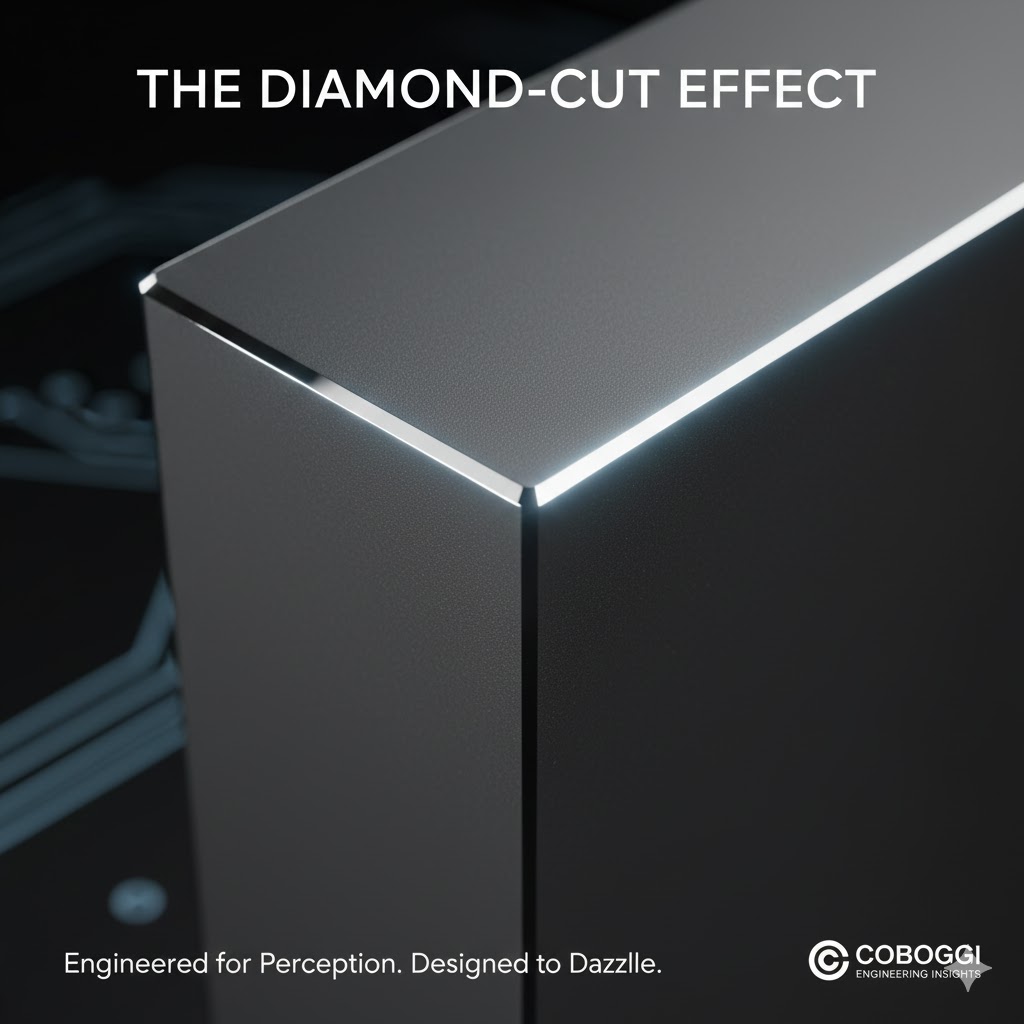
Aluminum’s greatest aesthetic asset is its reflectivity. A flat surface reflects light in one direction, but a 45-degree chamfer (bevel) catches light from multiple angles.
The Strategy: By "Diamond-Cutting" a bevel after the anodizing process, we expose the raw, polished aluminum beneath the color.
The Result: This creates a "Halo Effect" that frames the product, making it look thinner and more precisely manufactured.
The Business Logic: This visual "glint" is a subconscious signal of CNC Precision. It tells the customer, "This wasn't poured into a mold; it was carved from a solid block."
2. Improving Anodizing "Build-Up" and Durability
Physics dictates that electrical charges concentrate at sharp points. In the anodizing bath, this causes the protective oxide layer to be thinner and more brittle on sharp 90-degree corners.
The Problem: Sharp edges are the first place the finish will "chip" or "flake" if the product is bumped.
The Coboggi Solution: We apply a Micro-Radius or a Technical Bevel to every corner.
The ROI: This allows the anodized layer to wrap smoothly around the edge, significantly increasing the "Impact Resistance" of the finish.
3. Haptic Safety: The "Burr-Free" Guarantee
In handheld devices or medical tools, a "sharp" edge isn't just a quality issue—it’s a liability.
The Engineering: We use Multi-Axis CNC Chamfering to ensure that every human-contact point is "Touch-Safe."
The "Necessary Money" Investment: While "Tumbling" (vibratory finishing) can dull edges cheaply, it rounds them inconsistently. Coboggi uses dedicated CNC toolpaths to ensure every bevel is mathematically identical.
The Value: The product feels "soft" to the touch despite being made of hard metal. This is the hallmark of premium ergonomics.
4. Preventing "Stress Risers"
In structural aluminum components, a sharp internal corner is a "Stress Riser"—a place where cracks are likely to start under pressure.
The Tech: We engineer Fillets (curved internal bevels) into every corner of the internal chassis.
The Benefit: This distributes mechanical stress across a wider area, making the entire housing 20-30% stronger without adding weight.
The Business Logic: You are engineering against "Catastrophic Failure," ensuring the device survives real-world drops and pressure.
Conclusion: The Difference is in the Decimals
A bevel might only be 0.5mm wide, but that half-millimeter carries the weight of your brand’s perceived quality.
By mastering the physics of the edge, Coboggi ensures your product is safer, stronger, and more visually striking than anything else on the market.
 English
 German
 French
 Russian
 Spanish
 Japanese
 Korean
 Khmer
Khmer Portuguese
 Ukrainian
 Arabic
 Italian
 Afrikaans
 Albanian
 Armenian
 Azerbaijani
 Basque
 Belarusian
 Bulgarian
 Catalan
 Croatian
 Czech
Czech Danish
 Dutch
Dutch Estonian
 Filipino
 Finnish
 Galician
 Georgian
 Greek
Greek Haitian Creole
 Hebrew
 Hindi
Hindi Hungarian
 Icelandic
 Indonesian
 Irish
Irish Latvian
 Lithuanian
 Macedonian
 Malay
Malay Maltese
 Norwegian
 Persian
 Polish
 Romanian
 Serbian
 Slovak
 Slovenian
 Swahili
 Swedish
 Thai
Thai Turkish
 Urdu
Urdu Vietnamese
 Welsh
Welsh Yiddish