

In traditional manufacturing, "toolmarks" (the lines left by a cutting bit) are considered defects to be sanded away.
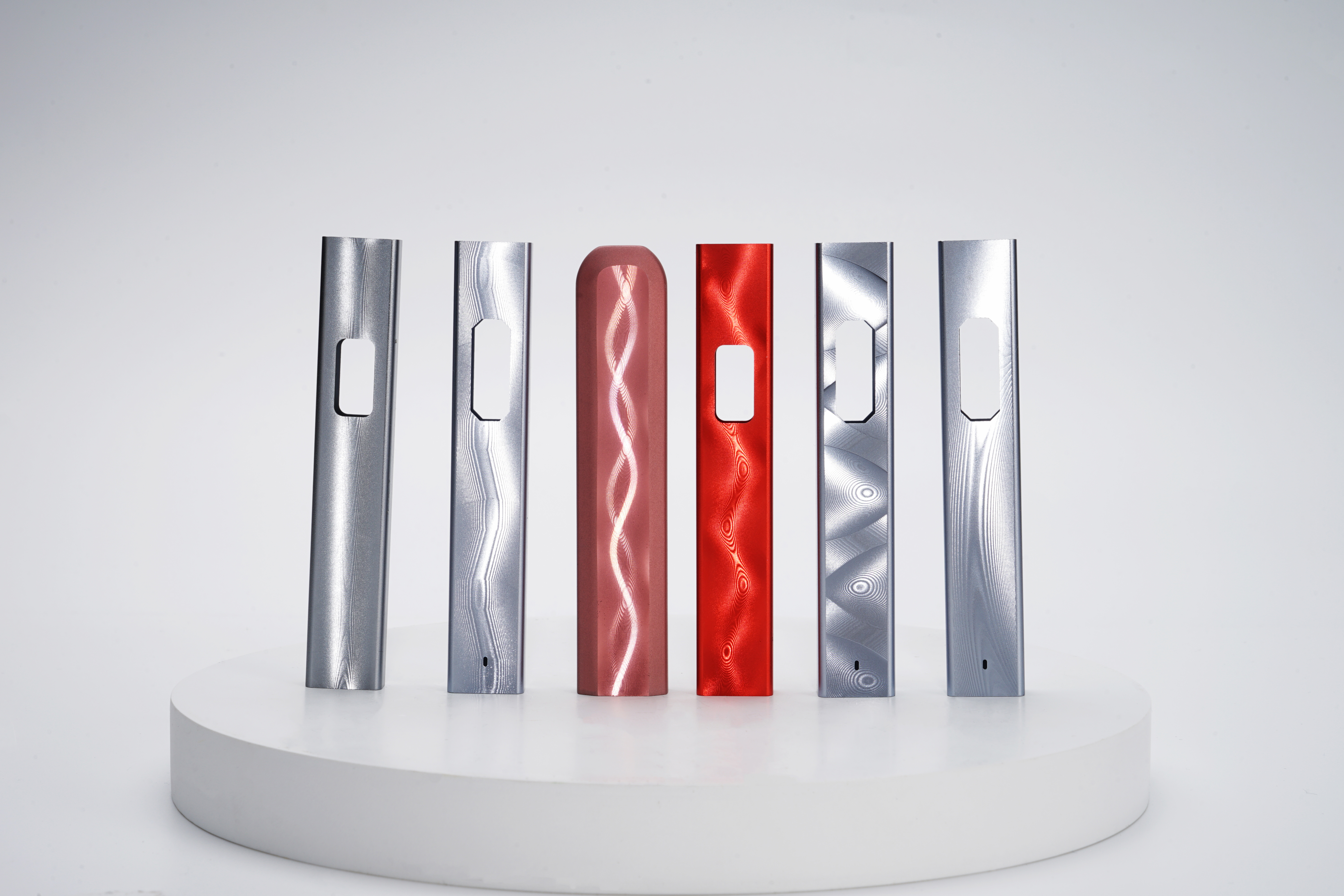
But in the world of Industrial Chic design, these marks are the main event. By precisely controlling the movement of the CNC spindle, we can create rhythmic, light-catching patterns that tell a story of precision.
At Coboggi, we turn "milling" into "art."
1. Designing the Toolpath
We don't just "cut" the metal; we "draw" on it with the CNC bit. We use specialized CAM (Computer-Aided Manufacturing) software to create intentional patterns:
Concentric Circles (The "Vinyl" Look): Perfect for volume knobs or camera lens rings, creating a "rainbow" refraction similar to a vinyl record.
Linear Micro-Grooves: Parallel lines that give a product a "brushed" look but with much more depth and regularity than manual brushing.
Cross-Hatch Textures: Intersecting paths that create a tactile, diamond-like grid.
2. The "3D Anodizing" Effect
When you anodize a machined texture, something magical happens. The dye settles into the microscopic grooves left by the tool.
High-Contrast Shading: The "valleys" of the toolmark hold more color, while the "peaks" reflect more light. This creates a natural gradient that makes the texture look much deeper than it actually is.
Metallic Lustre: Because the tool "burnishes" the metal as it cuts, the aluminum underneath the anodized layer remains incredibly bright, giving the color a metallic "glow."
[Image showing a macro view of concentric CNC toolmarks on a volume knob, colored with deep emerald green anodizing]
3. Why This Beats Traditional Brushing
Standard "Brushed Aluminum" is done with a belt or a wheel. It’s often irregular and "fuzzy."
Digital Consistency: With CNC texturing, every line is exactly 0.02mm apart. It is mathematically perfect.
Pattern Versatility: We can change the texture direction mid-part—for example, a circular texture on the top of a button and a vertical texture on the sides—creating a complex interplay of light.
4. Durability & Fingerprint Resistance
A major advantage of CNC Machined Textures is their practicality:
Masking Scratches: Because the surface already has a rhythmic pattern, "micro-scratches" from daily use become invisible.
Haptic Feedback: The ridges provide a high-quality "mechanical" feel, giving the user better grip and a sense of the material's strength.
5. Applications: Where the Machine Shines
Mechanical Keyboards: Using aggressive toolpaths on the "weight" or the casing for a premium, heavy-duty look.
Hi-Fi Audio Equipment: Faceplates that want to showcase the "billet aluminum" origin.
Professional Camera Gear: Dials and rings that require a precise, tactile "click" feel.
Conclusion: The Soul of the Machine
CNC Machined Texture + Anodizing is for the designer who loves the "Honesty of Materials." It doesn't pretend to be plastic or carbon fiber; it proudly announces that it was carved from a solid block of aluminum. At Coboggi, we provide the precision to make those toolmarks look like a masterpiece.
 English
 German
 French
 Russian
 Spanish
 Japanese
 Korean
 Khmer
Khmer Portuguese
 Ukrainian
 Arabic
 Italian
 Afrikaans
 Albanian
 Armenian
 Azerbaijani
 Basque
 Belarusian
 Bulgarian
 Catalan
 Croatian
 Czech
Czech Danish
 Dutch
Dutch Estonian
 Filipino
 Finnish
 Galician
 Georgian
 Greek
Greek Haitian Creole
 Hebrew
 Hindi
Hindi Hungarian
 Icelandic
 Indonesian
 Irish
Irish Latvian
 Lithuanian
 Macedonian
 Malay
Malay Maltese
 Norwegian
 Persian
 Polish
 Romanian
 Serbian
 Slovak
 Slovenian
 Swahili
 Swedish
 Thai
Thai Turkish
 Urdu
Urdu Vietnamese
 Welsh
Welsh Yiddish