

While the exterior of a COBOGGI enclosure focuses on tactile interface and branding, the interior of the Isogrid Chassis reveals the true secret to its durability: Geometric Reinforcement.
In the pursuit of the "portability" we established in our previous studies, we cannot simply rely on wall thickness. Instead, we use mathematical patterns to create strength.
Engineering Beyond Thickness
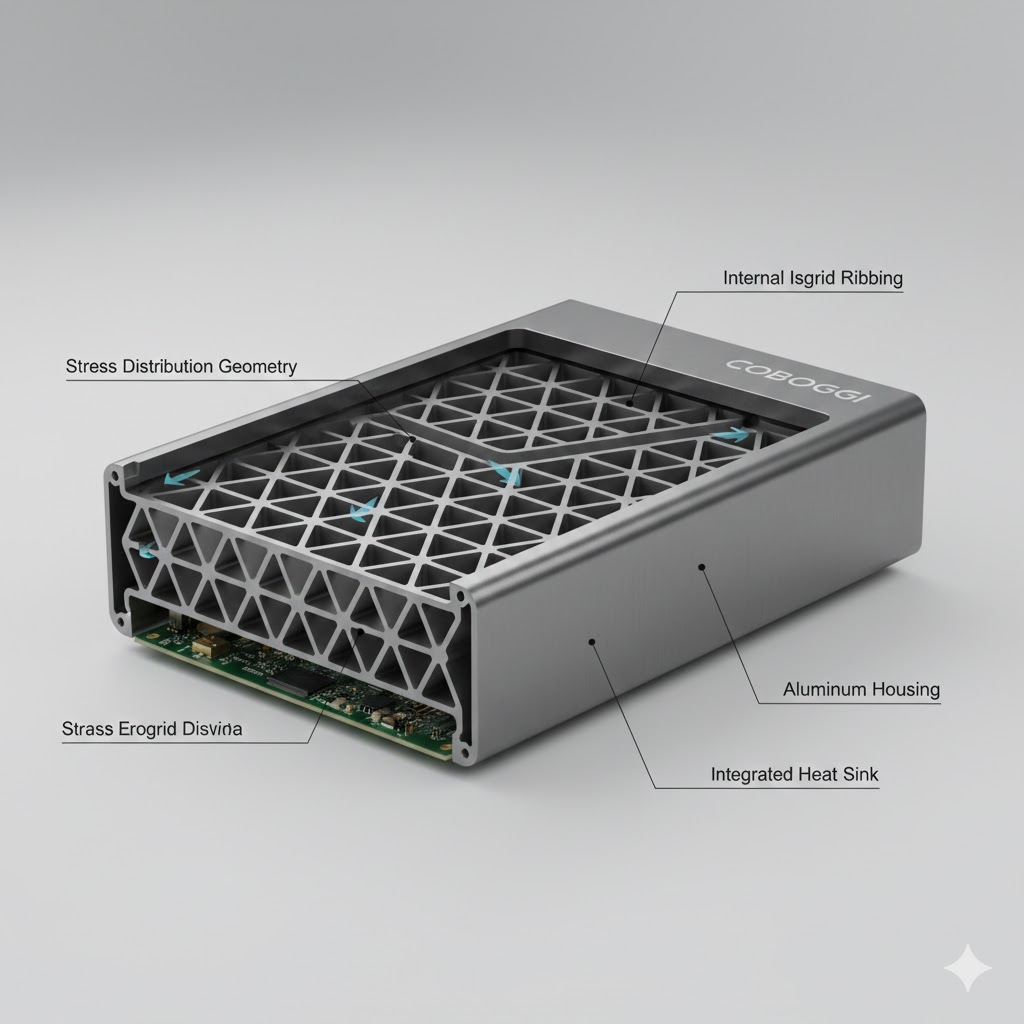
To maintain a lightweight profile without sacrificing crush resistance, the Isogrid Chassis utilizes an internal triangular reinforcement pattern. This allows us to redistribute mechanical stress across the entire frame rather than at a single point of failure.
1. The Isogrid Advantage
By machining a series of triangular ribs into the interior face of the aluminum housing, we increase the Moment of Inertia. This provides the stiffness of a much thicker plate while removing up to 40% of the material weight.
2. Vibration Damping
Portable hardware is often subjected to high-frequency vibrations—whether from industrial machinery or transit. The varying thickness of the internal ribs in the Isogrid Chassis is designed to disrupt harmonic resonance, protecting the sensitive solder joints on the internal PCB from fatigue.
3. Integrated Heat Sinking
These ribs serve a dual purpose. By increasing the internal surface area of the aluminum, they act as built-in heat sinks.
Thermal energy from the processor is pulled into the ribs and dissipated across the chassis, ensuring that the device remains cool during sustained high-performance tasks.
.png?x-oss-process=image/resize,m_pad,h_600,w_800)
 English
 German
 French
 Russian
 Spanish
 Japanese
 Korean
 Khmer
Khmer Portuguese
 Ukrainian
 Arabic
 Italian
 Afrikaans
 Albanian
 Armenian
 Azerbaijani
 Basque
 Belarusian
 Bulgarian
 Catalan
 Croatian
 Czech
Czech Danish
 Dutch
Dutch Estonian
 Filipino
 Finnish
 Galician
 Georgian
 Greek
Greek Haitian Creole
 Hebrew
 Hindi
Hindi Hungarian
 Icelandic
 Indonesian
 Irish
Irish Latvian
 Lithuanian
 Macedonian
 Malay
Malay Maltese
 Norwegian
 Persian
 Polish
 Romanian
 Serbian
 Slovak
 Slovenian
 Swahili
 Swedish
 Thai
Thai Turkish
 Urdu
Urdu Vietnamese
 Welsh
Welsh Yiddish