

As processors grow more powerful and compact, traditional heat sinks are reaching their physical limits. The future of thermal management lies in liquid cooling, but traditional plumbing is too bulky for sleek hardware.
COBOGGI solves this through Vacuum Brazing, a high-end joining process that allows us to "sandwich" complex internal fluid channels directly into an aluminum chassis.
The Anatomy of a Hermetic Bond
Vacuum brazing is a thermal joining process that takes place in a controlled atmosphere. It allows COBOGGI to join multiple layers of 6xxx or 3xxx series aluminum into a single, monolithic block with intricate internal labyrinths.
1. The Filler Foil and Capillary Action
Instead of melting the base aluminum, we place a thin layer of a specialized aluminum-silicon filler alloy (with a lower melting point) between the components.
As the temperature rises in the furnace, the filler melts and is drawn into the microscopic gaps between the parts by capillary action. This creates a bond that is as strong as the parent metal itself.
2. The Power of the Vacuum
Oxidation is the enemy of aluminum welding. By performing the brazing in a high-vacuum chamber (pressures as low as 10{-5}mbar), COBOGGI eliminates the need for corrosive flux.
The vacuum environment strips away the natural oxide layer of the aluminum, allowing the filler metal to "wet" the surfaces perfectly. This results in joints that are vacuum-tight and 100% leak-proof—essential for liquid-cooled electronics.
3. Complexity Without Compromise
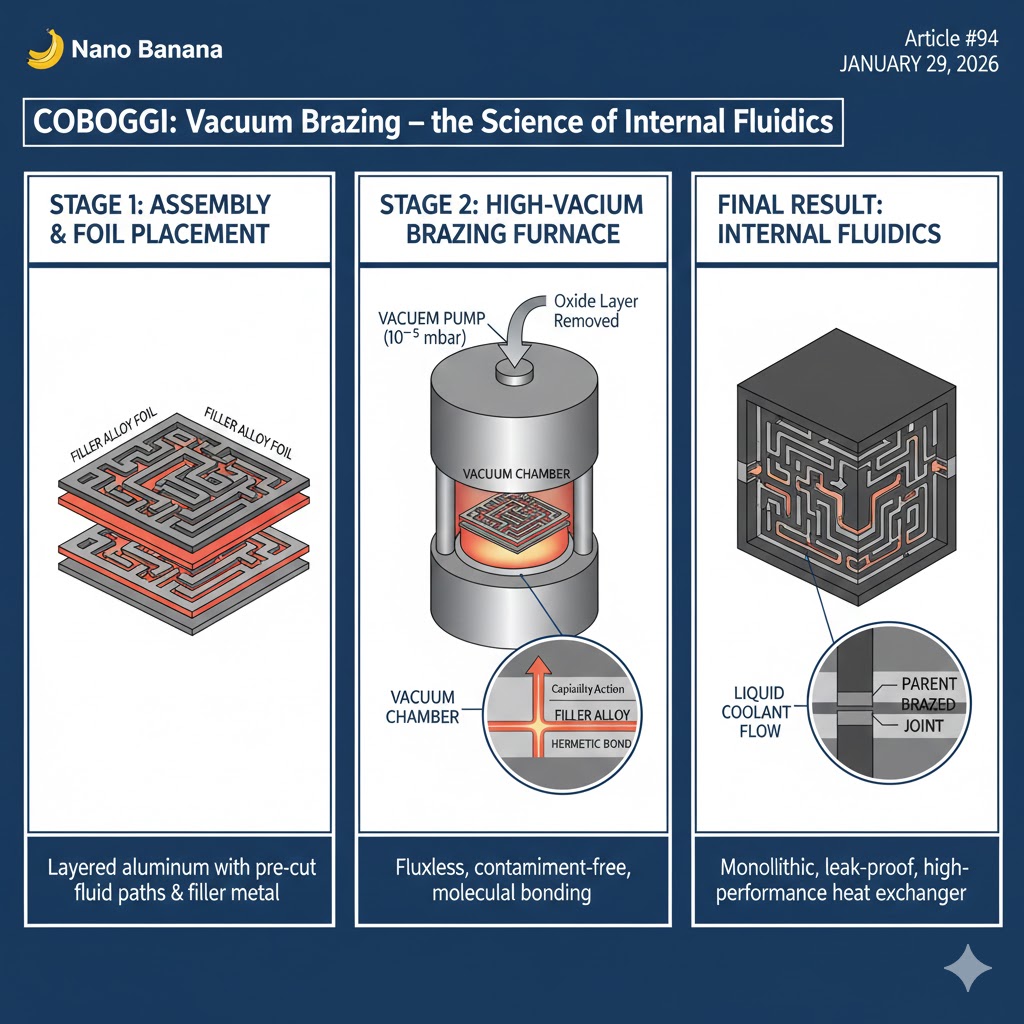
Because the process happens across the entire surface of the part simultaneously, we can create incredibly complex internal cooling paths.
We can braze a "maze" of fins and channels that maximize the surface area for heat transfer. The final part looks like a solid piece of aluminum from the outside, but inside, it is a high-performance heat exchanger.
Conclusion: Invisible Infrastructure
Vacuum brazing allows COBOGGI to hide the "engine" of the cooling system within the walls of the device.
It provides the thermal overhead required for next-generation AI and high-performance computing while maintaining the minimalist, unibody aesthetic our clients demand.

 English
 German
 French
 Russian
 Spanish
 Japanese
 Korean
 Khmer
Khmer Portuguese
 Ukrainian
 Arabic
 Italian
 Afrikaans
 Albanian
 Armenian
 Azerbaijani
 Basque
 Belarusian
 Bulgarian
 Catalan
 Croatian
 Czech
Czech Danish
 Dutch
Dutch Estonian
 Filipino
 Finnish
 Galician
 Georgian
 Greek
Greek Haitian Creole
 Hebrew
 Hindi
Hindi Hungarian
 Icelandic
 Indonesian
 Irish
Irish Latvian
 Lithuanian
 Macedonian
 Malay
Malay Maltese
 Norwegian
 Persian
 Polish
 Romanian
 Serbian
 Slovak
 Slovenian
 Swahili
 Swedish
 Thai
Thai Turkish
 Urdu
Urdu Vietnamese
 Welsh
Welsh Yiddish