

A robot is essentially a collection of "Actuators" (muscles) and "Skeletons" (bones).
In the emerging world of household assistants, delivery bots, and companion droids, the choice of material for these components is a high-stakes decision.
Steel is too heavy; plastic is too flexible. Aluminum is the "Goldilocks" material—offering the perfect balance of High Power-to-Weight Ratio and Dimensional Stability.
At Coboggi, we are the "Bone-Builders" for the robotic age.
1. The "Power-to-Weight" Mandate
In robotics, every extra gram of weight in a limb requires more battery power and stronger motors to move.
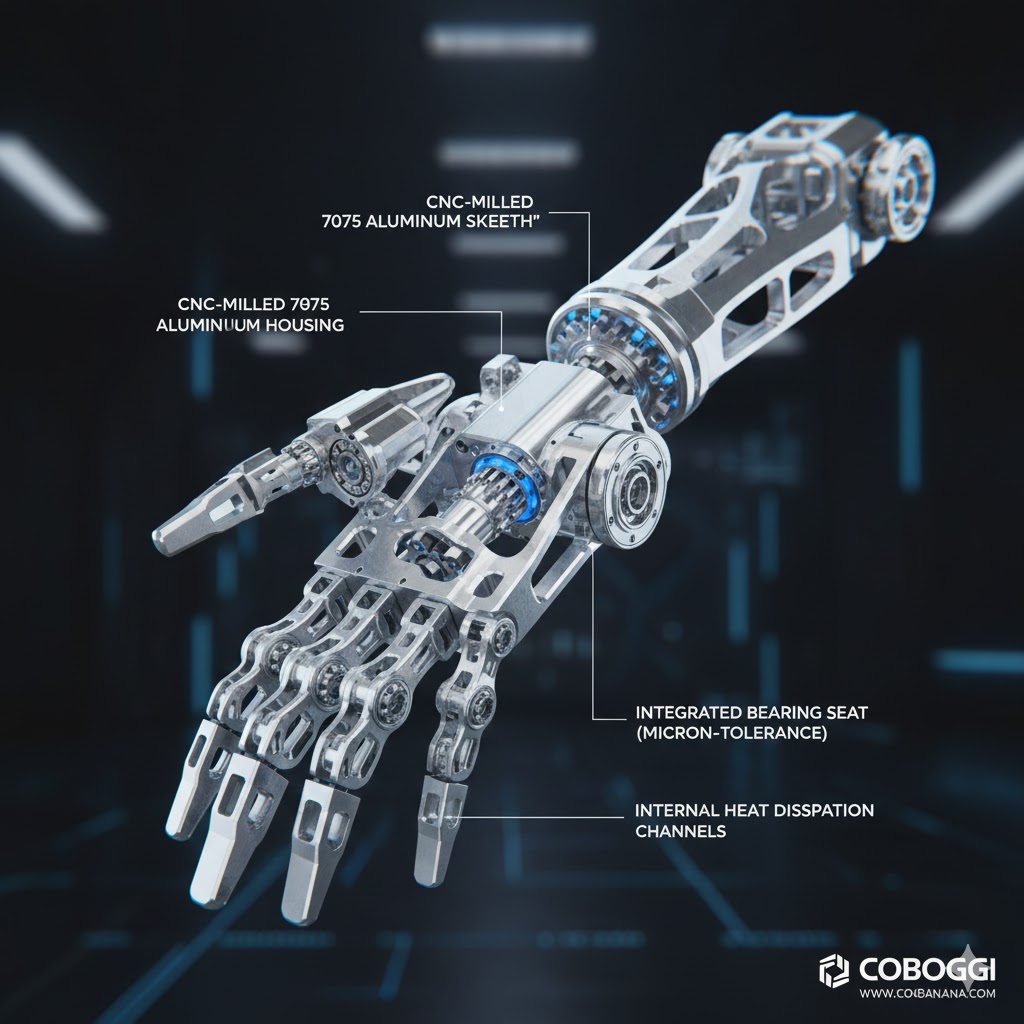
Hollow-Core Machining: We use advanced CNC techniques to create hollowed-out "skeletal" limbs. These parts look solid on the outside but feature intricate internal lattices that reduce weight by up to 60% while maintaining the stiffness required for precise movement.
Aerospace Alloys (2000/7000 Series): For high-stress joints, we utilize alloys that provide the fatigue resistance needed for millions of repetitive cycles.
2. Precision at the Joint
A robot’s "intelligence" is limited by its "mechanics." If a robot arm has even 0.05mm of "play" or "slop" in its joints, it cannot perform delicate tasks like picking up a glass of water.
Micron-Level Bearing Seats: We machine the housings for bearings and motors with sub-micron tolerances. This ensures that the fit is perfectly "snug," eliminating vibrations and ensuring smooth, fluid motion.
Integrated Sensor Mounts: We CNC-mill mounting points for LiDAR, cameras, and infrared sensors directly into the head and chest frames, ensuring the robot’s "eyes" never lose their calibration.
3. Thermal Dissipation for High-Torque Motors
Robotic motors (especially in "legs" or "hands") generate intense heat. If this heat isn't managed, the motors will throttle or fail.
The Frame as a Radiator: By mounting motors directly to an aluminum chassis, we turn the entire limb into a heat sink. The thermal conductivity of aluminum pulls heat away from the motor coils, allowing the robot to operate for longer periods at higher speeds.
4. Human-Robot Interaction (HRI) Aesthetics
Consumer robots shouldn't look like scary factory machines. They need a "Soft Industrial" look.
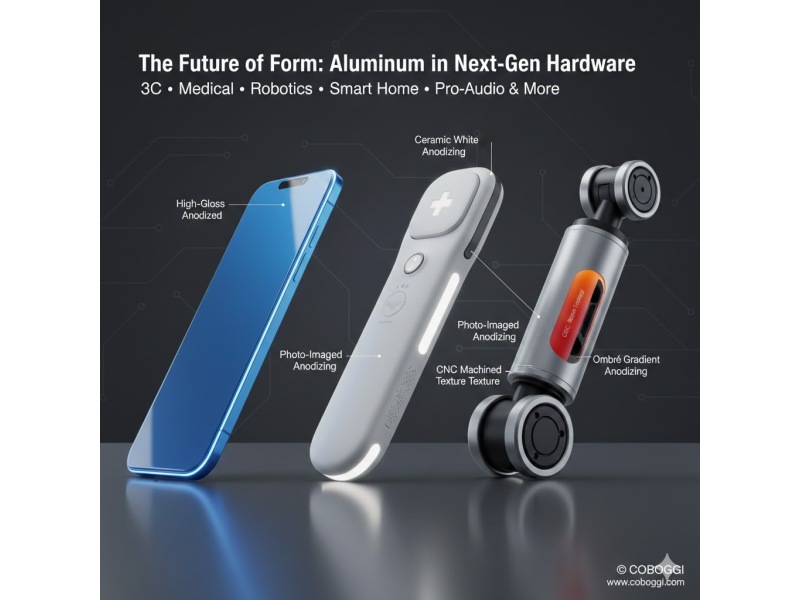
Satin Anodizing: We use fine-bead blasting and soft-colored anodizing (Pearl White, Space Gray, Pale Blue) to give the metal a "tech-skin" look that feels approachable and premium.
Seamless Shells: We specialize in large-format CNC shells that hide the wires and sensors, creating a clean, "unibody" robot exterior that is easy to wipe down and maintain.
5. Applications: Building the New Workforce
Companion Robots: Lightweight aluminum skeletons that make the robot safe to have around children and pets.
Delivery Droids: Rugged, weather-resistant chassis that protect the cargo and electronics from the elements.
Exoskeletons: Precision-milled "wearable" aluminum parts that must align perfectly with human anatomy.
Conclusion: Precision in Motion
The future of robotics isn't just about AI; it's about the hardware that carries that AI. At Coboggi, we provide the skeletal precision and thermal engineering that allows robots to move with grace, strength, and reliability.
 English
 German
 French
 Russian
 Spanish
 Japanese
 Korean
 Khmer
Khmer Portuguese
 Ukrainian
 Arabic
 Italian
 Afrikaans
 Albanian
 Armenian
 Azerbaijani
 Basque
 Belarusian
 Bulgarian
 Catalan
 Croatian
 Czech
Czech Danish
 Dutch
Dutch Estonian
 Filipino
 Finnish
 Galician
 Georgian
 Greek
Greek Haitian Creole
 Hebrew
 Hindi
Hindi Hungarian
 Icelandic
 Indonesian
 Irish
Irish Latvian
 Lithuanian
 Macedonian
 Malay
Malay Maltese
 Norwegian
 Persian
 Polish
 Romanian
 Serbian
 Slovak
 Slovenian
 Swahili
 Swedish
 Thai
Thai Turkish
 Urdu
Urdu Vietnamese
 Welsh
Welsh Yiddish