

The future of human-computer interaction isn't on a desk; it's on our faces and hands.
For AR/VR headsets and "Smart Glasses," the challenge is brutal: you must pack a high-powered computer, batteries, and lenses into a frame that weighs as little as possible.
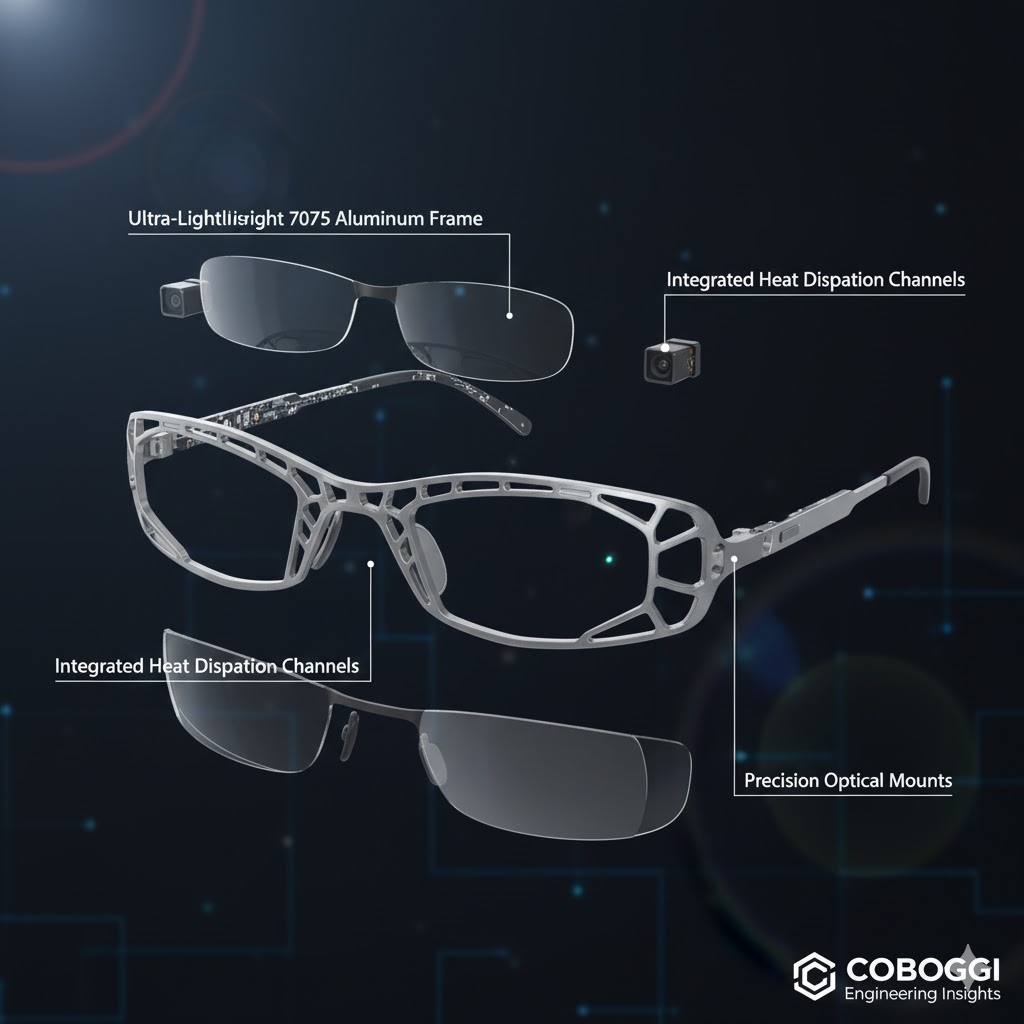
Aluminum is the essential bridge in this category. It provides the Rigidity needed for optical alignment and the Thermal Conductivity needed to keep processors from overheating against the user's skin.
1. Skeletal Strength: The Structural Frame
In a VR headset, the "Chassis" must be perfectly rigid. If the frame flexes by even 0.01mm, the lenses lose alignment, causing motion sickness for the user.
Pocketing & Light-weighting: We use "Blind-Hole Milling" and complex internal pocketing to remove 70% of the metal's mass, leaving behind a "web" or "lattice" structure that is incredibly strong but feather-light.
Magnesium-Aluminum Alloys: For the most extreme cases, we utilize specialized alloys that offer the density of plastic with the stiffness of metal.
2. Heat Management in Close Proximity
AR/VR chips run hot. Unlike a laptop, you can't have a loud fan blowing next to a user's ear.
The Body as a Heat Sink: The entire aluminum exterior frame is often designed to act as a radiator.
Integrated Heat Pipes: We machine precision channels into the aluminum frame to seat copper heat pipes, ensuring heat is moved away from the face and toward the outer edges of the device.
3. Optical Bench Precision
The "Optical Engine" (the projectors and mirrors in AR glasses) requires sub-micron precision.
Datum-Point Machining: We machine the mounting points for lenses and sensors in a single setup on a 5-axis CNC. This eliminates "stack-up errors," ensuring that the virtual world aligns perfectly with the real world.
Vibration Damping: Aluminum’s natural damping characteristics help stabilize the micro-displays against the small vibrations caused by head movement.
4. Haptics: The Feel of Interaction
For controllers and haptic gloves, the "click" and "vibration" need to feel crisp.
Inertial Clarity: Aluminum transmits haptic vibrations (from linear actuators) much more clearly than plastic, which tends to "muffle" the sensation.
Wear-Resistant Ports: Charging ports and physical buttons are reinforced with anodized aluminum to withstand thousands of cycles of "blind" plugging while the user is inside a virtual environment.
5. Applications: Shaping the Metaverse
AR Smart Glasses: Ultra-slim aluminum temples (arms) that look like high-end eyewear.
VR Headset Front-Plates: Acting as both a structural shield and a thermal radiator.
Haptic Controllers: Precision-balanced aluminum triggers and shells for a premium "pro-gaming" feel.
Conclusion: Making the Invisible, Physical
Next-gen hardware should disappear. It should be so light and so well-balanced that the user forgets they are wearing it. At Coboggi, we provide the "Invisible Infrastructure"—the ultra-light, ultra-strong aluminum components that make the magic of AR and VR possible.
 English
 German
 French
 Russian
 Spanish
 Japanese
 Korean
 Khmer
Khmer Portuguese
 Ukrainian
 Arabic
 Italian
 Afrikaans
 Albanian
 Armenian
 Azerbaijani
 Basque
 Belarusian
 Bulgarian
 Catalan
 Croatian
 Czech
Czech Danish
 Dutch
Dutch Estonian
 Filipino
 Finnish
 Galician
 Georgian
 Greek
Greek Haitian Creole
 Hebrew
 Hindi
Hindi Hungarian
 Icelandic
 Indonesian
 Irish
Irish Latvian
 Lithuanian
 Macedonian
 Malay
Malay Maltese
 Norwegian
 Persian
 Polish
 Romanian
 Serbian
 Slovak
 Slovenian
 Swahili
 Swedish
 Thai
Thai Turkish
 Urdu
Urdu Vietnamese
 Welsh
Welsh Yiddish