

In premium industrial design, there is a concept called "Monolithic Beauty."
It is the illusion that a complex electronic device—made of dozens of internal parts—has been carved from one single, solid block of metal.
Achieving this "No-Gap" look is one of the hardest challenges in manufacturing. When two pieces of aluminum meet, even a hair-width misalignment can catch the light, creating a "shadow line" that makes the device feel cheap. At Coboggi, we turn invisible seams into a repeatable standard.
1. The Science of the "Hairline" Joint
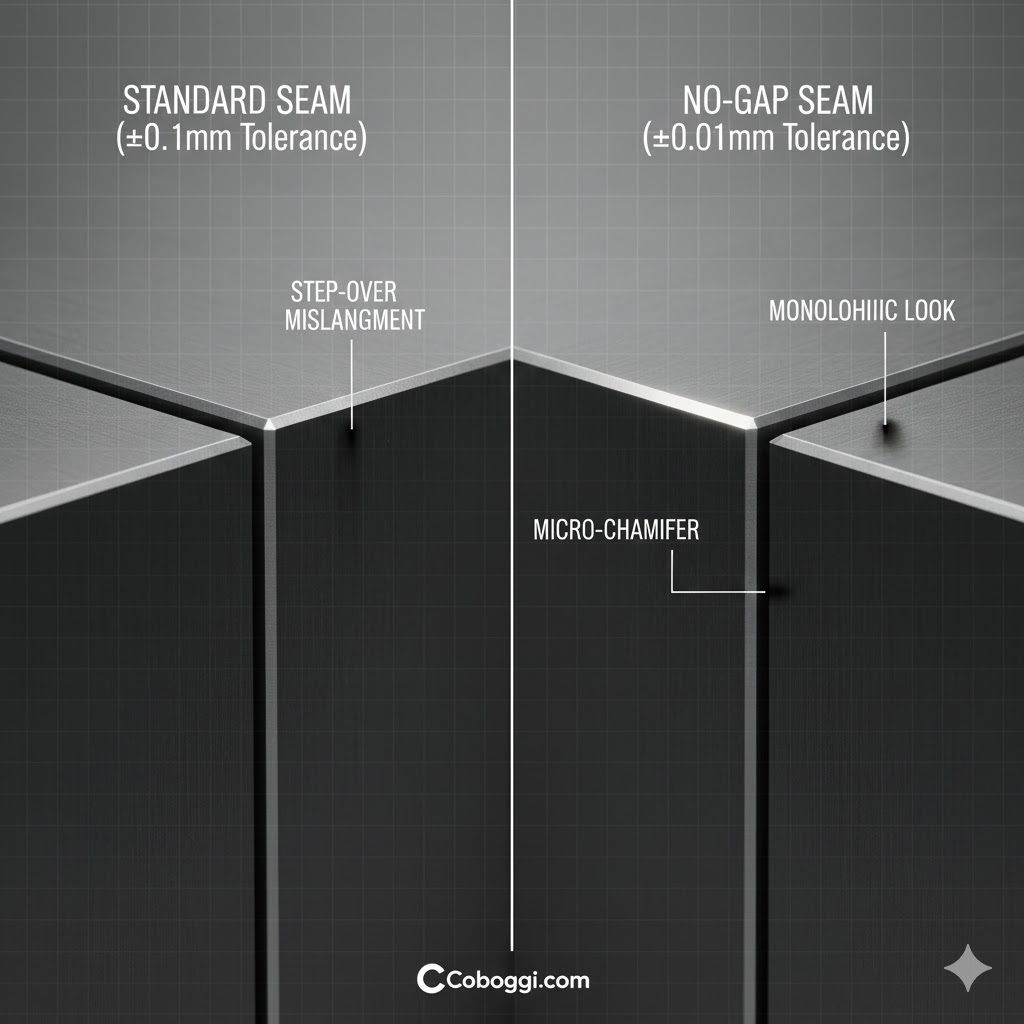
To the human eye, a gap becomes visible at roughly 0.05mm. To make a seam "disappear," the tolerance of the mating parts must be significantly tighter than that.
The Coboggi Standard: We machine mating surfaces to ±0.01mm.
Why it works: By ensuring that the "Male" and "Female" edges of an enclosure are perfectly parallel and flat, the two parts compress together so tightly that light cannot enter the crack, eliminating the shadow that reveals a seam.
2. Managing "Step-Over" Misalignment
A seam isn't just about the gap between parts; it’s about the flushness (the height difference) between them. If one part is 0.02mm higher than the other, you will feel a sharp edge when you slide your finger across it.
The Solution: We use integrated machining. We often mount the two halves of an enclosure together during the final finishing pass of the CNC process. This ensures the outer profile is cut as one continuous surface, guaranteeing a perfectly flush transition.
3. The Role of Anodizing in Seam Design
Anodizing adds a layer of aluminum oxide to the surface, which actually increases the dimensions of the part by a few microns.
The Engineering Challenge: If you don't account for the thickness of the anodized layer (5 μm to 20 μm), the parts that fit perfectly as raw metal will no longer close properly after they are colored.
Coboggi's Precision: We calculate the "Anodizing Allowance" into our CAD models, ensuring the "No-Gap" fit is achieved after the final finish is applied.
4. Sharp Edges vs. Micro-Chamfers
True "zero-gap" design often requires a Micro-Chamfer (a tiny $45^\circ$ angle at the edge).
The Optical Illusion: By adding a 0.05mm chamfer to both mating edges, we create a deliberate, microscopic V-shape. This catches the light uniformly, making the transition look like an intentional design element rather than a manufacturing error.
5. Applications: Where "No-Gap" Matters Most
High-End Remote Controls: Where the hand is constantly feeling the edges.
Luxury Laptop Chassis: Where the lid meets the palm rest.
Boutique Audio DACs: Where a solid, "heavy" look is essential for brand identity.
Conclusion: Precision You Can Feel
The "No-Gap" aesthetic is the ultimate expression of manufacturing mastery. It tells the customer that every micron of their device was considered. At Coboggi, we don't just make boxes; we create seamless experiences.

 English
 German
 French
 Russian
 Spanish
 Japanese
 Korean
 Khmer
Khmer Portuguese
 Ukrainian
 Arabic
 Italian
 Afrikaans
 Albanian
 Armenian
 Azerbaijani
 Basque
 Belarusian
 Bulgarian
 Catalan
 Croatian
 Czech
Czech Danish
 Dutch
Dutch Estonian
 Filipino
 Finnish
 Galician
 Georgian
 Greek
Greek Haitian Creole
 Hebrew
 Hindi
Hindi Hungarian
 Icelandic
 Indonesian
 Irish
Irish Latvian
 Lithuanian
 Macedonian
 Malay
Malay Maltese
 Norwegian
 Persian
 Polish
 Romanian
 Serbian
 Slovak
 Slovenian
 Swahili
 Swedish
 Thai
Thai Turkish
 Urdu
Urdu Vietnamese
 Welsh
Welsh Yiddish